e-Portfolio Reflections and Evaluation
Learning Journey by Unit
This section summarises my progression through the module, highlighting key outputs and lessons learned.
Unit 1: Introduction to Research Methods and Ethics
I explored inductive and deductive reasoning and connected ethics to everyday technology decisions. The Menlo Report's beneficence principle became central to how I think about security research, particularly around participant protection. The discussion on AI ethics (Kluge Corrêa et al., 2023) informed my later work on API security governance.
Unit 2: Research Questions and Literature Review
I learned to transform a broad interest in cloud security into focused research questions. The process of building a literature review plan taught me to distinguish between summarising sources and synthesising them into a coherent argument. This groundwork directly shaped my proposal on Shadow APIs.
Unit 3: Methodology and Research Methods
I matched methodological choices to research aims rather than defaulting to familiar approaches. The mixed methods design I ultimately chose for my proposal emerged from understanding when quantitative measurement needs qualitative explanation. Saunders, Lewis and Thornhill (2019) provided the framework for aligning philosophy with method.
Unit 4: Case Studies, Focus Groups, and Observations
This unit showed me how qualitative methods capture context that numbers miss. I gained appreciation for how developer behaviour and organisational culture influence security outcomes, which became a core argument in my research proposal about why Shadow APIs emerge from workflow friction rather than technical ignorance.
Unit 5: Interviews, Surveys, and Questionnaire Design
I developed a sharper eye for survey design flaws. Examining how biased questions and weak consent undermine both data quality and participant trust reinforced the ethical dimensions of data collection. These lessons will directly inform my planned survey instrument on security protocol circumvention.
Unit 6: Descriptive Statistics
I built foundational statistical skills for describing data distributions. Understanding measures of central tendency and spread prepared me for the inferential work ahead. As someone more comfortable with systems than statistics, this unit required deliberate effort but proved essential for interpreting research evidence.
Unit 7: Inferential Statistics and Hypothesis Testing
I worked through t tests and F tests using Excel, learning to state hypotheses clearly and interpret results without overreaching. The distinction between statistical significance and practical significance was particularly valuable. I now understand how to test whether observed differences in my future survey data reflect real patterns or chance variation.
Unit 8: Data Analysis and Visualisation
I recognised charts as evidence tools rather than decoration. The exercises on histograms and bar charts showed how visualisation choices affect interpretation. Poor chart design can mislead, while effective visualisation communicates findings clearly to stakeholders who may not engage with raw statistics.
Unit 9: Validity and Generalisability
I applied validity and reliability concepts to evaluate both sources and my own research design. Understanding the limits of generalisability helped me set realistic expectations for what my mixed methods study can claim. Findings from 50 survey respondents and 10 interviews will need careful framing.
Unit 10: Research Writing
I learned that strong research requires clear communication, not just technical expertise. Each dissertation section serves a distinct purpose and must connect logically. This unit helped me structure my literature review and proposal presentation more effectively by separating description from analysis.
Unit 11: Professional Development and the e-Portfolio
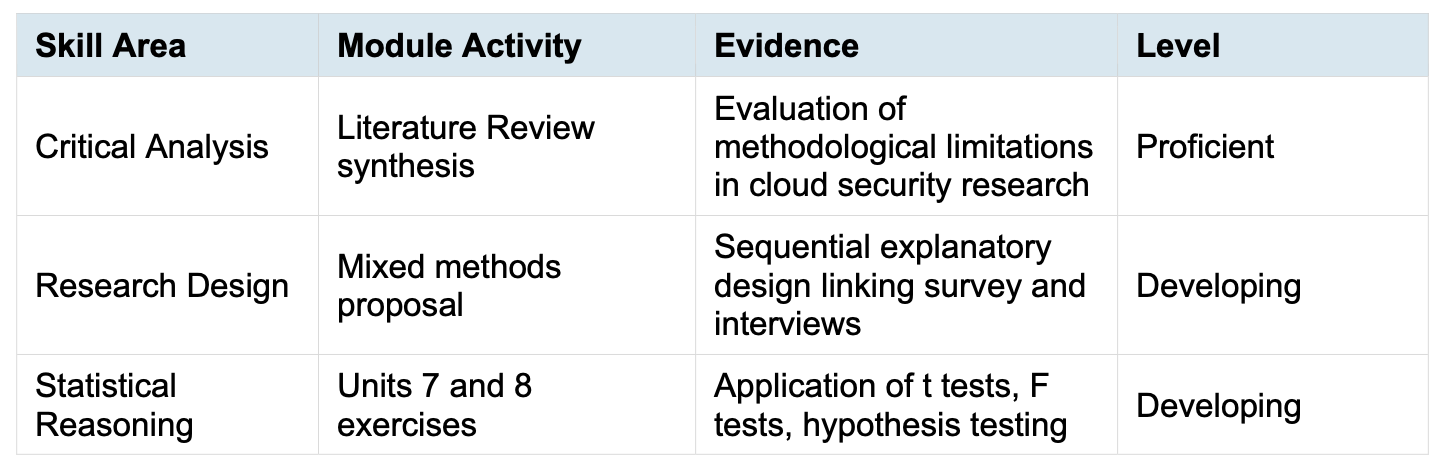
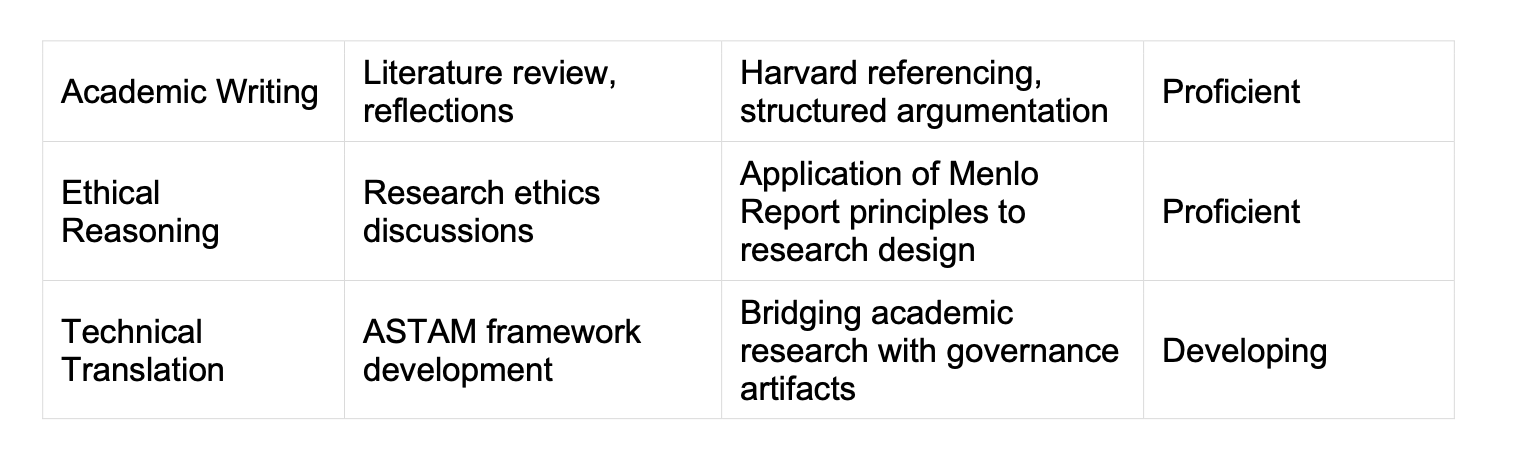
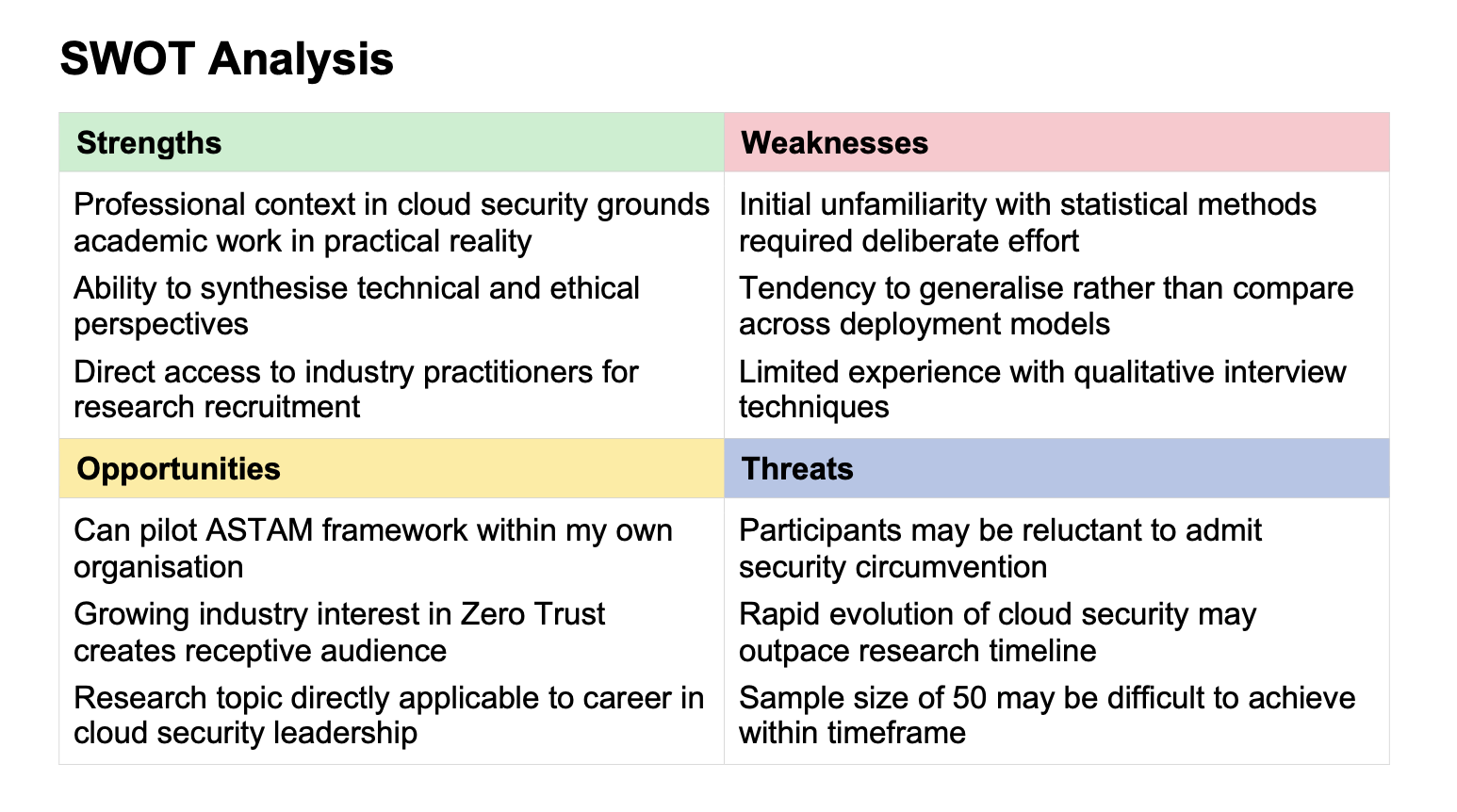
I began treating the e-Portfolio as an evolving record of professional growth rather than a static submission. The Professional Skills Matrix helped me map strengths against development gaps. Integrating reflective entries throughout the module created a clear narrative of my progression.
Unit 12: Project Management and Risk
I understood project management as dynamic decision making rather than linear task scheduling. The emphasis on continuous risk monitoring aligned with my professional experience in SRE, where uncertainty is constant. The PMBOK framework (PMI, 2021) provided structure for thinking about my research timeline and potential obstacles.
Literature Review and Research Proposal Evaluation
Literature Review Feedback
My literature review received positive feedback for demonstrating comprehensive understanding of cloud security as a sociotechnical challenge. The tutor noted that the work "effectively connects technical vulnerabilities with ethical governance frameworks" and that the critical engagement was sustained throughout, "systematically analysing discrepancies across the literature." The synthesis was described as demonstrating "depth of analysis" rather than mere summary, with particular effectiveness in examining the compliance gap between theory and practice.
Areas for Improvement: The key area for improvement identified was extending the synthesis to include comparative evaluation between deployment models, such as public versus hybrid cloud. This is valid feedback. I focused on general cloud security principles without exploring how risks manifest differently across deployment contexts. Hybrid environments present unique challenges around data residency and policy complexity that I did not address.
Research Proposal Feedback
For the research proposal, feedback highlighted the clear framing of the research problem and the coherent link between methodology and artifact development. The tutor noted that "the explanatory sequential mixed-methods design is appropriate for measuring prevalence and explaining causal mechanisms." The ethical considerations around participant self incrimination were described as "critically examined" with appropriate mitigation measures.
Areas for Improvement: Areas for improvement included introducing academic definitions for core constructs like "shadow APIs" earlier in the presentation and comparing existing DevSecOps automation frameworks to strengthen the case for ASTAM's novelty. The feedback also suggested clearer articulation of potential limitations in survey sampling and interview recruitment.
I will carry this feedback forward by incorporating deployment model comparisons into my survey and interview instruments, ensuring questions capture differences between public, hybrid, and multi cloud contexts. I will also position the ASTAM framework more explicitly against existing solutions in future writing.
Professional Skills Matrix and SWOT Analysis
Action Plan
Based on this analysis, I have identified three priority actions:
- Strengthen statistical capabilities: I will continue practicing with statistical software and complete additional exercises on regression analysis before beginning data collection. This addresses the weakness identified during Units 7 and 8.
- Develop comparative analysis skills: Acting on tutor feedback, I will incorporate questions about deployment models into my survey and interview instruments to generate the comparative data that was missing from my literature review.
- Build interview experience: Before conducting formal research interviews, I will practice semi structured interviewing with colleagues to develop skills in probing responses while maintaining ethical sensitivity.
References
- Correa, N.K. et al. (2023) 'Worldwide AI ethics: a review of 200 guidelines and recommendations for AI governance', Patterns, 4(10), pp. 1-15.
- PMI. (2021) A guide to the project management body of knowledge (PMBOK guide). 7th edn. Newtown Square: Project Management Institute.
- Saunders, M.N.K., Lewis, P. and Thornhill, A. (2019) Research methods for business students. 8th edn. Harlow: Pearson.